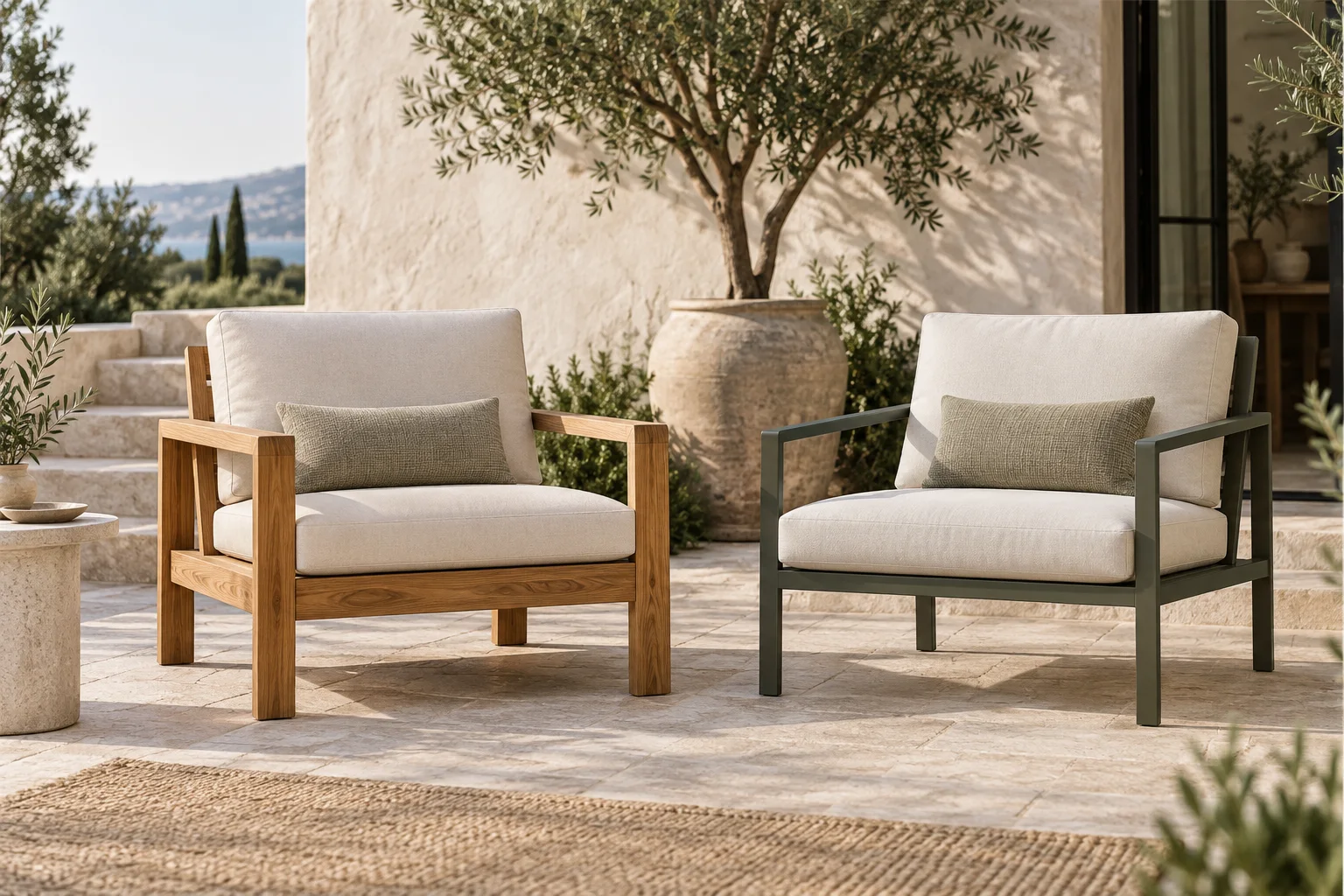
Teak and aluminium can both make durable outdoor furniture, but they achieve it in very different ways. Teak relies on the natural properties of its heartwood and a surface that can be renewed. Aluminium relies on a corrosion-resistant metal, thoughtful construction and, in most furniture, a protective decorative finish.
So which one lasts longer? There is no honest universal winner. A well-made piece of either material can outlast a poorly made version of the other. The better choice depends on exposure, construction, maintenance, wind, comfort and the way you want the furniture to age.
The short answer
Choose teak if you want a warm natural surface, accept gradual silvering and prefer a piece that can be cleaned, sanded carefully and visually renewed.
Choose powder-coated aluminium if you want light furniture, frequent movement, crisp shapes and limited routine maintenance.
For salt air, strong wind or permanent exposure, the design details become more important than the material name. Finish quality, fasteners, drainage and storage decide whether the furniture remains easy to own.
Teak and aluminium side by side
| Question | Teak | Powder-coated aluminium |
|---|---|---|
| Visual character | Warm, tactile, natural variation | Clean, consistent, broad colour range |
| Weathering | Moves toward silver-grey when left untreated | Finish should remain stable; chips and salt deposits need attention |
| Weight | Usually heavier | Usually lighter |
| Routine care | Cleaning; optional appearance treatments | Cleaning; inspect coating and joints |
| Repair | Surface can often be renewed | Finish repair is more product-specific |
| Wind | Weight can be useful | Light pieces need secure storage or suitable bases |
| Strong sun | Timber feels visually soft; surface can still become hot | Dark finishes can become noticeably hot |
| Salt air | Durable timber, but clean hardware and joints | Rinse salt; coating, alloy and fastener compatibility matter |
| Buying concern | Timber grade, joints and responsible sourcing | Welds, finish preparation, drainage and warranty |
What outdoor weather does to teak
Teak heartwood is valued for natural durability and dimensional stability. The US Forest Products Laboratory notes its high natural durability and long history in boats and furniture. Those properties help explain why teak performs well outdoors, but they do not eliminate variation between products.
Furniture quality depends on the timber selected, how it was dried, the proportion of heartwood, joint design and assembly. A thick board does not guarantee good construction, and the label “teak” does not describe the grade or source.
Left untreated, teak's exposed surface normally changes from golden brown toward grey. Owners sometimes interpret this as damage, but colour change and structural decay are not the same thing. Dirt, algae, cracking, loose joints and trapped moisture deserve attention; an even silver surface may simply be the chosen finish.
If you want to preserve a brown appearance, follow the maker's care system rather than applying generic oil automatically. Some treatments change colour, attract dirt or create a maintenance cycle the owner did not expect.
What outdoor weather does to aluminium
Aluminium develops a naturally protective oxide layer when exposed to air. Outdoor furniture generally adds a powder-coated or painted finish that supplies colour and contributes further protection.
Unlike steel, aluminium does not produce red iron rust. It is still possible for localised corrosion or staining to occur, particularly around chloride-rich salt, damaged finishes, tight crevices or contact between incompatible metals. European Aluminium notes that chloride ions can disrupt the protective oxide layer locally. That is why “rust-free” should not be interpreted as “ignore forever.”
Rinse salt and grime, keep drainage openings clear and inspect chips. Avoid abrasive cleaners unless the manufacturer explicitly approves them. The most durable frame is a complete system: suitable alloy, clean welds, good pretreatment, a consistent finish and compatible fasteners.
Maintenance: renewal versus inspection
Teak asks you to decide what appearance you want. For a natural grey surface, maintenance can remain simple: remove debris, wash gently and let the furniture dry. For a warmer brown appearance, care becomes more frequent and product specific.
Aluminium usually asks less aesthetic maintenance. Wash the frame, clear dirt from joints and check for coating damage. Repair options vary by finish. A small mark may accept a manufacturer-approved touch-up; extensive coating failure is not equivalent to lightly sanding a timber surface.
Neither material benefits from being wrapped while damp. Breathable, correctly fitted covers and dry storage reduce the time surfaces remain wet.
Weight and movement
This is one of the clearest practical differences.
Teak furniture tends to feel planted. That can be valuable on an open terrace or in a dining layout that stays in place. It can be inconvenient when furniture moves daily, travels up stairs or must be stored in a compact area.
Aluminium is useful for balconies, flexible dining and seasonal storage because it is comparatively light. In exposed wind, however, a light chair may move before a heavier teak chair does. Evaluate the individual piece: base width, centre of gravity and storage plan matter more than a catalogue photograph.
For balcony styling, combine the material decision with the circulation principles in Small Balcony, Big Atmosphere.
Heat and comfort in strong sun
Any outdoor surface can become uncomfortable in direct sun. Dark aluminium finishes often absorb noticeable heat, while pale finishes tend to be more forgiving. Timber also warms, but its tactile character differs from metal.
Shade and airflow are better solutions than assuming one material stays cool. Test armrests and seat edges before sitting, especially around pools where bare skin contacts the frame. Cushions and slings improve comfort but introduce their own drying and storage needs.
Appearance after several seasons
Teak makes ageing visible. Grain, small checks, repairs and grey colour become part of the object. This suits a relaxed Mediterranean or natural garden palette. The existing CasaLume guide to a calm Mediterranean patio shows how timber works with stone, linen and terracotta.
Aluminium aims for greater visual consistency. It can form thin profiles, continuous curves and precise modular shapes. Ageing often appears as small finish marks rather than a complete colour transformation.
Neither approach is inherently better. Decide whether you enjoy patina or prefer a stable painted surface.
Poolside and salt-air use
Around a pool, quick cleaning and drying are essential. Aluminium's low weight and smooth finish are convenient, but finish quality and compatible fasteners still matter. Teak offers a natural surface with established marine use, but hardware, joints and cleaning must not be ignored.
Near the sea, salt collects on both materials. Rinse surfaces with fresh water according to the maker's guidance, pay attention to joints and avoid storing damp cushions against the frame. Aluminium deserves particular inspection at chips and mixed-metal connections; teak deserves inspection around hardware and areas that stay wet.
The CasaLume poolside furniture guide explains how frames, fabrics and maintenance work together in wet settings.
Responsible buying questions
For teak, ask:
- What species and grade is used?
- Is the visible timber heartwood, and how was it dried?
- What is the documented country and chain of custody?
- Can the seller's certification claim be verified?
- Are replacement parts available?
FSC has continued to investigate integrity risks in parts of the teak supply chain. A logo is a reason to verify a certificate, not a reason to stop asking questions.
For aluminium, ask:
- Is the frame cast, extruded or fabricated, and where are the drainage points?
- How was the surface prepared before coating?
- What does the finish warranty cover?
- Are stainless or other fasteners isolated appropriately from the frame?
- Can feet, slings, cushions and connectors be replaced?
These questions reveal more than an undefined promise of “premium outdoor quality.”
Which should you choose?
Choose teak when:
- You want natural material and visible grain.
- The furniture will remain mostly in one place.
- You accept silver-grey weathering or a deliberate care routine.
- Surface repairability matters.
- You can verify responsible sourcing.
Choose aluminium when:
- Furniture must move frequently.
- You prefer crisp profiles and a consistent colour.
- You want a simple wash-and-inspect routine.
- Seasonal storage space is limited.
- The individual product has a credible finish and frame warranty.
Look beyond both when:
- You need substantial weight with very slim sections: coated steel may suit the space.
- You prioritise the simplest possible cleaning: dense recycled plastic may be worth comparing.
- You want a soft lounge shape in a covered setting: quality synthetic wicker may provide the right texture.
The complete CasaLume outdoor furniture materials guide compares those alternatives in more detail.
The CasaLume verdict
Teak wins for natural tactility, graceful surface renewal and reassuring weight. Aluminium wins for mobility, design flexibility and a lower-effort visual finish. Longevity belongs to the well-designed piece that fits its environment and receives the modest care it actually needs.
Choose the ownership experience you prefer. Then inspect the joints, finish, fasteners, drainage and warranty before being persuaded by the material name alone.
Sources
- USDA Forest Products Laboratory: Wood Handbook
- USDA Forest Products Laboratory: Outdoor Furniture, Artwork, Fences, and Play Equipment
- The Aluminum Association: Aluminum Properties
- European Aluminium: Corrosion and the natural oxide layer
- Forest Stewardship Council: Investigation into FSC's Teak Corridor