A small patio does not need a complete makeover. It needs one clear purpose, comfortable circulation and a few details that make people want to stay. The most successful low-cost changes usually begin with editing and rearranging—not shopping.
Use these fifteen ideas in order. Start with the free improvements, identify the single constraint that still bothers you, and spend there first.
Before you buy: measure the usable space
Measure the patio, the door swing and the route people use to reach the garden or house. Keep the main path open and note where sun, wind and rain arrive. A quick sketch with furniture dimensions prevents the most expensive small-space mistake: buying a piece that technically fits but blocks movement.
Choose one primary use. A compact patio can be an excellent dining space or a generous two-person lounge. Trying to make it both at the same time often produces a crowded compromise.
Five changes that cost nothing
1. Clear one continuous path
Move pots, side tables and spare chairs away from the natural route. An uninterrupted strip of visible floor immediately makes a patio feel larger and safer.
2. Turn the furniture toward a view
Face seating toward planting, evening light or the most attractive wall. Furniture pushed against every edge can feel accidental; a deliberate orientation creates a room.
3. Remove the weakest third
Take away broken planters, faded ornaments and objects without a job. Fewer, larger elements usually look calmer than many small ones.
4. Borrow furniture from another room
Test the scale with a stool, folding chair or small table you already own. Move indoor pieces back inside after use unless they are made for outdoor exposure.
5. Group pots instead of scattering them
Three pots arranged at different heights make a stronger focal point than the same pots distributed around the perimeter. Keep the heaviest pots where they will not need frequent moving.
Five low-cost upgrades
6. Change the light temperature
Warm, shielded light is more inviting than a single bright source. Use products specifically rated for their location, keep plugs and connections dry, and follow the manufacturer's installation instructions.
7. Add one large planter
One substantial pot gives the eye somewhere to rest and can make several smaller containers feel intentional. Choose a plant for the real light and wind conditions, not only for the photograph on its label.
8. Repeat one textile colour
Two cushion covers or a washable throw in the same muted colour can connect mismatched furniture. Store textiles dry and choose removable covers when possible.
9. Refresh only the surface that matters
Clean the floor, wash the furniture and touch up compatible finishes before replacing anything. Always follow the material maker's care instructions, especially on powder coating and treated timber.
10. Create a simple focal wall
Where rules allow, place a freestanding planter, outdoor artwork or tall pot against the least attractive wall. One vertical element adds depth without taking much floor space.
Five changes worth a little more
11. Choose a table with a small footprint
A round pedestal table can reduce corner collisions; a folding table can release floor space after dinner. Check the real dimensions with masking tape before buying.
12. Use chairs that move easily
Folding or stackable chairs let the patio change between daily use and occasional guests. Comfort still matters: a chair that is always folded away is not a bargain.
13. Define the seating area with a rain-ready rug
An outdoor rug can unify mixed furniture, but it should not trap water or obstruct the door. Leave visible floor around it and lift it periodically so both surfaces can dry.
14. Add removable shade
A correctly sized umbrella can make the patio usable for more hours. Map the sun first and choose a base and wind rating according to the manufacturer's guidance. For more options, see patio shade ideas without a permanent roof.
15. Buy one flexible piece
A sturdy stool can work as a seat, side table or plant stand. A small bench can seat two while keeping the visual line simpler than two bulky chairs. Flexible pieces earn their space.
Three realistic budget levels
| Budget level | Spend priority | Typical result |
|---|---|---|
| Almost free | Edit, clean, rotate the layout and regroup plants | Better circulation and a calmer view |
| Modest | Warm lighting, two textile covers and one focal planter | More atmosphere and visual consistency |
| Focused upgrade | Compact table or chairs, then removable shade | A more useful patio with fewer compromises |
Prices vary by country and season, so set the amount after deciding which constraint matters most. If afternoon sun prevents use, shade comes before decoration. If the door cannot open comfortably, furniture scale comes before textiles.
Mistakes that make a small patio feel smaller
- Buying a complete matching set before measuring the circulation path
- Using many tiny decorations with no visual hierarchy
- Choosing deep lounge furniture for a space used mainly for dining
- Covering every edge with planters
- Installing lighting that is too bright or unsuitable for outdoors
- Adding a rug that holds water beneath it
- Treating every idea as a requirement
A simple order of work
- Measure the patio and door swing.
- Choose dining, lounging or flexible use as the priority.
- Clear the route and remove visual clutter.
- Test a new layout for one week.
- Improve light and planting.
- Buy only the item that fixes the remaining constraint.
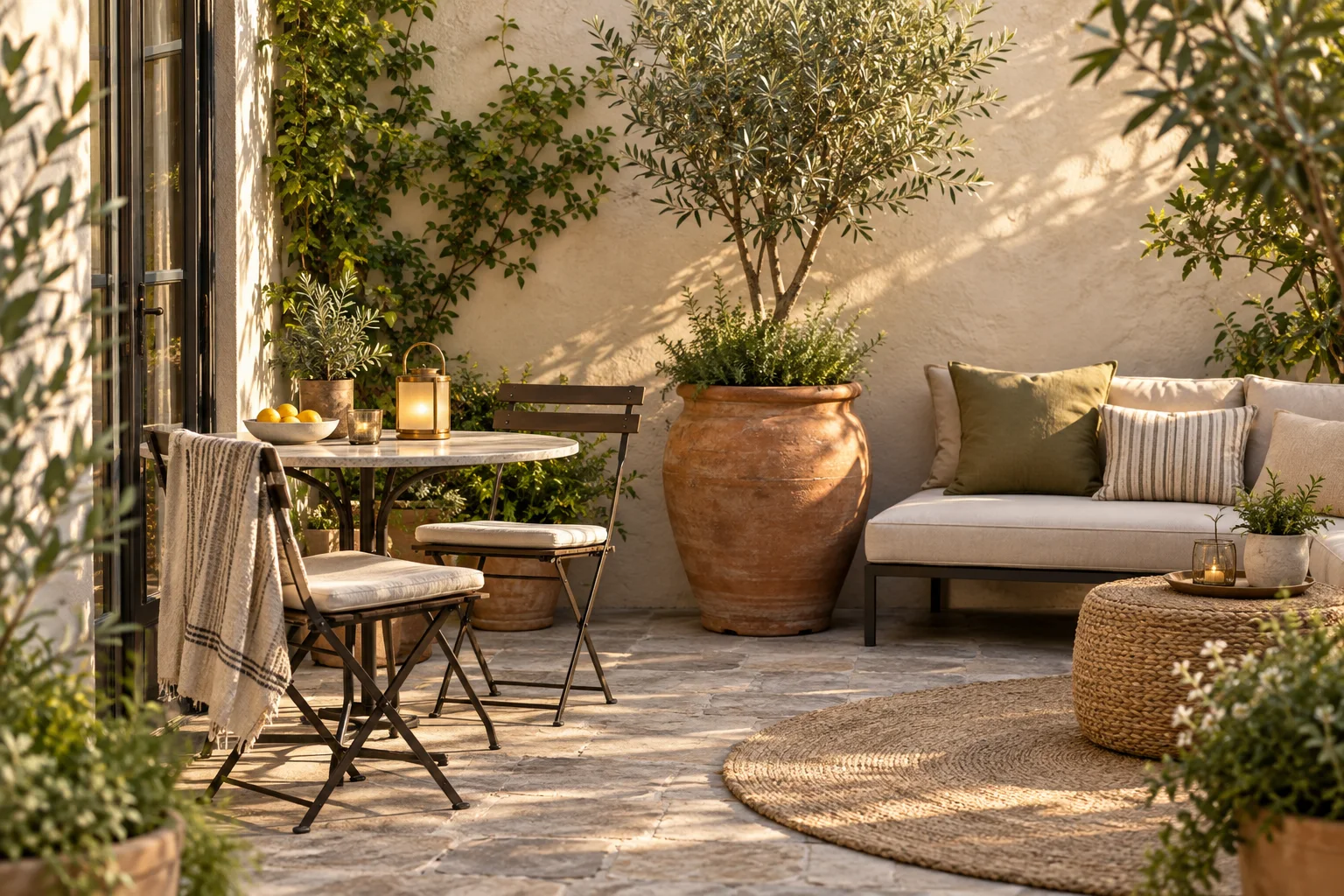
CasaLume's calm Mediterranean patio shows how a restrained palette and natural textures can make simple furniture feel considered. The lesson is not to copy every object. It is to repeat a few materials, preserve space around them and let the patio breathe.