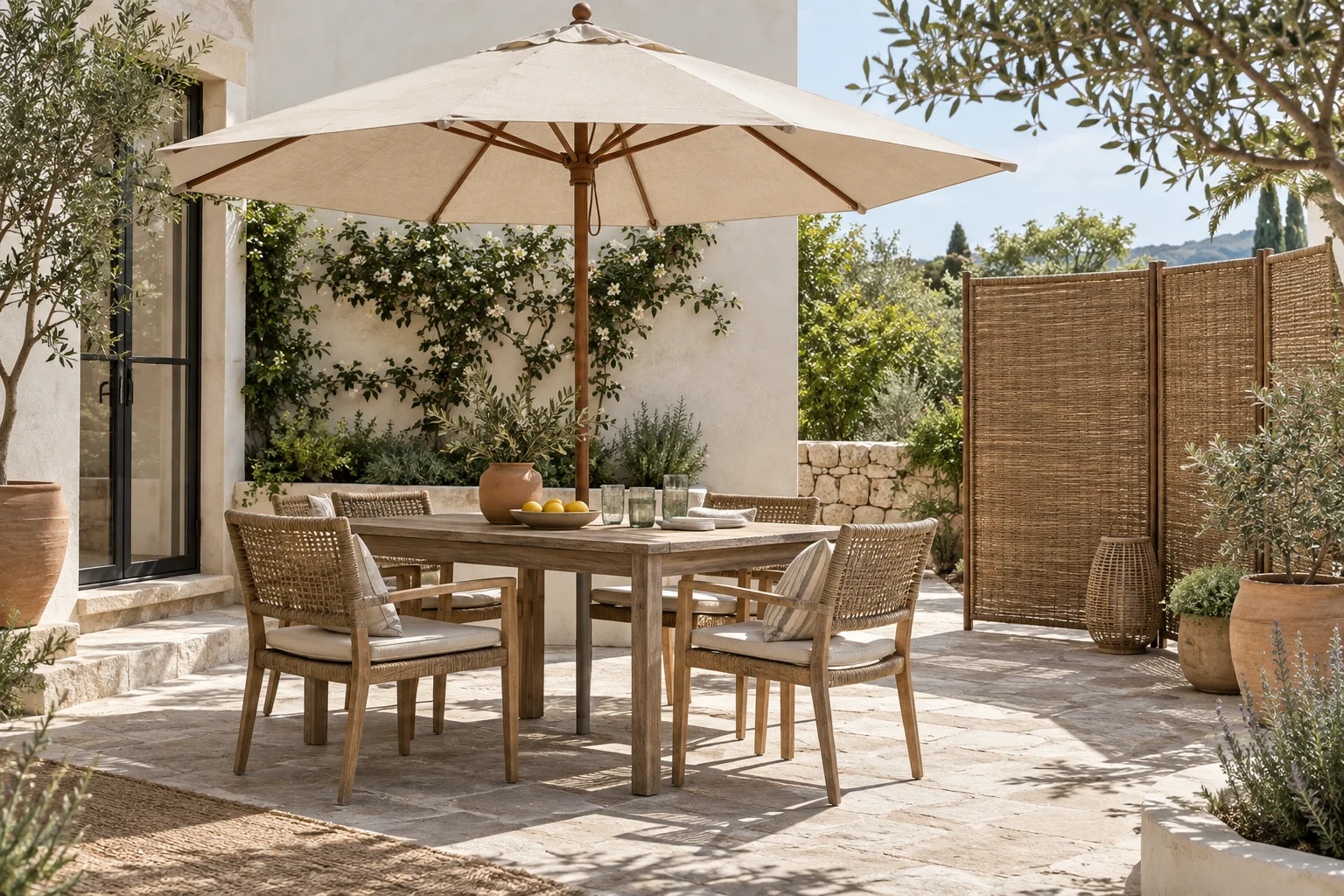
The best patio shade is not the largest object you can fit. It is the option that covers the right place at the right hour, works with wind and drainage, and can be moved or stored when conditions change.
Before choosing an umbrella, awning or canopy, observe the patio on a sunny day. Mark where shade is needed for morning coffee, lunch and late-afternoon seating. The sun moves, so a fixed patch measured at noon rarely tells the whole story.
Start with a simple sun map
Take three photographs from the same position—morning, midday and late afternoon. On a quick patio sketch, shade the areas already protected by walls or trees. Then mark the table, lounge chair and circulation route.
This reveals whether you need overhead shade from high sun, vertical protection from low western sun, or both. It also prevents a common mistake: placing a beautiful umbrella where its shadow misses the seating.
Patio shade options at a glance
| Option | Best quality | Main constraint | Storage or movement |
|---|---|---|---|
| Market umbrella | Familiar, flexible and widely sized | Central pole and base use floor space | Closes; some models move easily |
| Cantilever umbrella | Off-centre shade over a table or lounge | Requires a substantial compatible base | Rotates on some models; bulky to store |
| Retractable awning | Adjustable shade with a clear floor | Building approval and professional fixing may be needed | Retracts in place |
| Freestanding canopy | Covers a larger zone without a roof build | Footprint, wind and drainage | Seasonal disassembly varies |
| Shade sail | Light visual effect and broad coverage | Safe anchor loads require expert assessment | Fabric may be removable |
| Screen or planting | Helpful for low-angle sun and privacy | Limited overhead protection | Freestanding options can move |
Market umbrellas: simple and adaptable
A centre-pole market umbrella suits a dining table designed with a parasol hole or a small seating group where the pole will not interrupt movement. It is often the easiest option to replace, close or store.
Measure the furniture group rather than the whole patio. The canopy should shade the occupied area without scraping walls or projecting into a neighbour's space. Use the base specified for the umbrella and exposure. Never improvise with a light decorative stand in a windy location.
Cantilever umbrellas: shade without a central pole
A cantilever umbrella suspends the canopy from a side mast, leaving the shaded floor more open. It works well over a lounge or a table without a centre hole.
The trade-off is the base. The offset canopy creates leverage, so the support can be large and heavy. Check the full base footprint, rotation clearance and the manufacturer's wind instructions before purchase. On a small patio, draw the mast, base and open canopy on the plan—not only the shaded circle.
Retractable awnings: adjustable but not always renter-friendly
A retractable awning can provide clean, adjustable shade while preserving floor space. It can be useful where the sun reaches the same façade for much of the day.
Although it is not a permanent roof, it normally attaches to a building. Landlord, building and local requirements may apply, and the supporting structure must be suitable. Installation and wind limits belong to the product maker and qualified installer; they are not a do-it-yourself guess.
Freestanding canopies and pergola-style frames
Freestanding frames can define a larger outdoor room without constructing a roof. Some use retractable fabric; others use removable slats or curtains.
Check whether the product is genuinely freestanding, how rain leaves the fabric and where the feet sit. A frame that fits the patio dimensions may still block the door or create awkward corners. Follow the maker's anchoring, weather and seasonal-storage instructions.
Shade sails: visually light, structurally demanding
Shade sails can look effortless, but their anchors carry tension and weather loads. Existing fences, railings and decorative posts should not be assumed suitable. Local rules and a qualified assessment may be necessary.
If safe anchor points do not already exist, choose another solution rather than inventing them. A sail also needs an intentional slope so rain does not pool, plus clear guidance on when it must be removed.
Screens, curtains and planting for low sun
Overhead canopies are less effective when the sun is low. A freestanding outdoor screen, movable planter or properly designed exterior curtain can reduce glare from the side and add privacy.
Keep airflow and sightlines in mind. Tall objects can catch wind, and balcony or terrace rules may restrict screens. Weighted freestanding designs are often easier to adapt than anything attached to a railing.
How to choose for your patio
For a rented home
Begin with a market umbrella, cantilever umbrella or freestanding screen. Confirm lease and building rules before attaching anything to a wall, railing or structure.
For a very small patio
Map the base and door swing first. A compact centre-pole umbrella through the table may use less total floor than a cantilever base, even if the cantilever looks cleaner in photographs.
For a windy position
Treat manufacturer wind limits as operating rules, not marketing details. Close or remove shade when instructed, and never leave it open unattended in changing weather.
For afternoon western sun
Combine modest overhead shade with a movable side screen or planting. Low sun often passes beneath a high canopy.
A five-point shade checklist
- Photograph the sun at three times of day.
- Measure the furniture group, base footprint and opening clearance.
- Check building, lease and neighbour constraints.
- Follow the product's wind, anchoring and drainage guidance.
- Plan where the shade will be stored or closed when not in use.
Shade should improve the way the patio works without making it feel crowded. Once the practical layer is solved, small patio ideas on a budget can help you refine furniture, lighting and planting in the right order. For material choices that suit exposure, use the complete outdoor furniture materials guide.